
Dates are among the most consumed dried fruits in the world, and their richness in fiber, natural carbohydrates, and micronutrients makes them a preferred food to replace refined sugar. The question that deserves to be asked is not so much whether dates are good for health, but rather how to use them without turning every bite into an uncontrolled sugar intake.
Whole dates, date paste, date syrup: what each form really offers
Not all dates are created equal depending on how they are processed. The whole date retains its fiber intact, which slows down carbohydrate absorption. Date paste, made by blending the fruits with a little water, retains a good portion of this fiber but facilitates overconsumption because it is less precisely measured than a whole fruit.
Date syrup, on the other hand, loses a significant fraction of the fiber during filtration. Its profile is closer to that of a classic liquid sugar, even though it retains some polyphenols absent from white sugar. Date syrup is not a health food by default, and using it as a simple substitute for sugar without adjusting the quantities amounts to reproducing the same pattern of overconsumption.
Several studies in food technology, including a review from King Saud University published in 2022, have tested the use of date paste to reformulate snacks and cereal bars to reduce added sugar. The interest lies in the fact that date paste provides fiber and polyphenols where refined sugar only provides empty calories. You will find more tips on TwimmCook to vary the uses of this fruit in your daily life.

Glycemic impact of dates in a complete daily diet
Talking about the glycemic index of dates in isolation doesn’t say much. A fruit consumed alone on an empty stomach does not have the same effect as the same fruit integrated into a meal containing proteins, fats, and other fibers. It is the overall dietary context that determines the glycemic response.
Dates at breakfast: a common trap
Adding two or three Medjool dates to a bowl of porridge or yogurt does little to change the glycemic load of the meal if it already contains proteins and fats. In contrast, spreading date paste on white bread without a protein accompaniment causes a glycemic spike comparable to that of a classic jam.
The difference lies in the food matrix: the whole date, with its fibrous structure, requires a longer chewing and digestion time. The paste, already deconstructed, is absorbed more quickly.
Dates as a snack: the question of quantities
One to two whole dates after lunch or in the mid-afternoon represent a reasonable intake. Beyond three or four fruits, one enters a zone where the intake of simple carbohydrates becomes significant, especially if the rest of the day already includes fruits, bread, or starchy foods.
The available data do not allow for a universal threshold, as glycemic tolerance varies among individuals, their physical activity, and their sensitivity to insulin. The most reliable benchmark remains consistency with the overall carbohydrate intake of the day.
Cooking with dates without accumulating hidden sugars
Dates find their most interesting place in cooking when they replace a sweetener rather than when they are added to an already sweet dish. The distinction seems simple, but it is often overlooked in popular recipes that combine dates, honey, and agave syrup in the same dessert.
- In a cake or brownie, date paste can replace all the added sugar if the recipe is reformulated accordingly, not simply by adding dates on top of the initial sugar amount.
- In a smoothie, a single Medjool date is enough to sweeten a mixture of milk, banana, and cocoa. Adding two or three transforms the drink into a high-calorie dessert.
- In savory dishes (tagines, sauces, marinades), dates provide a subtle sweetness that balances acidity or spiciness, as long as one does not exceed two to three fruits for four servings.
Replacing sugar with dates only makes sense if the total amount of sweetener decreases. Substituting one ingredient without adjusting the dosage amounts to changing the label without altering the content.
Varieties of dates and choices based on nutritional use
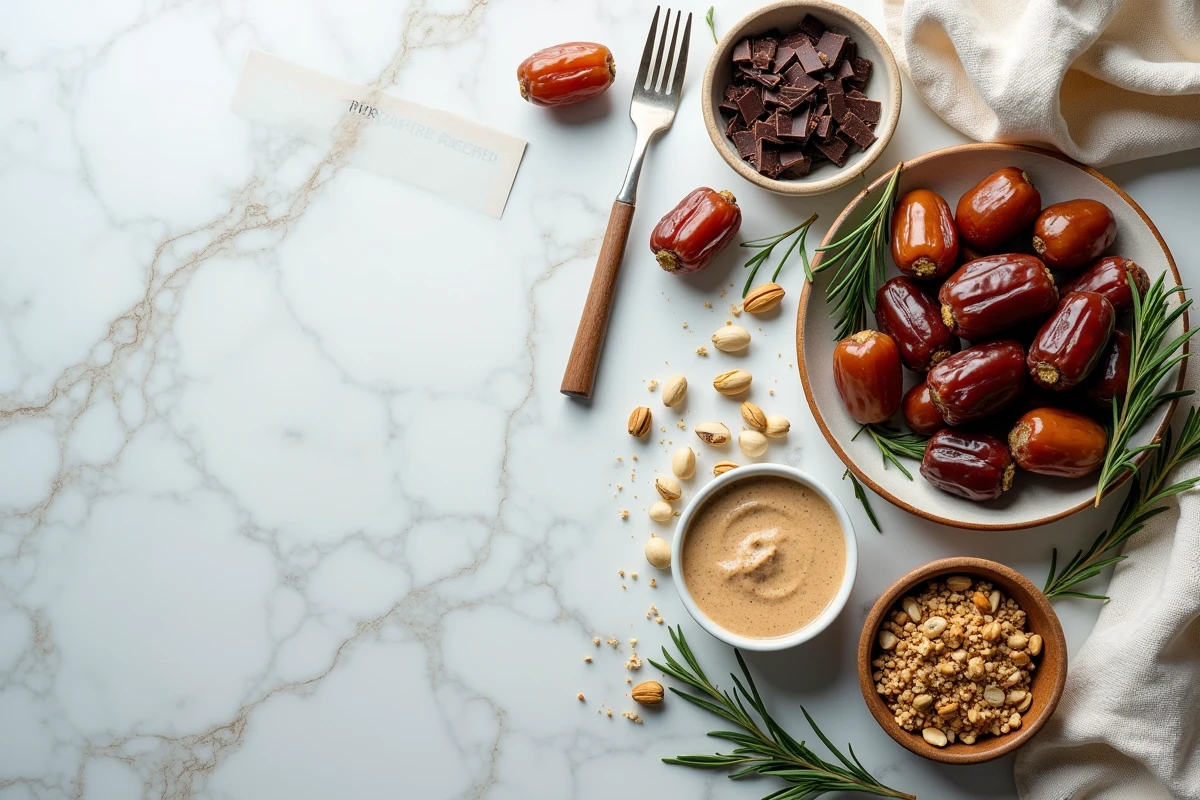
The variety directly influences the water content, carbohydrate concentration, and texture. Medjool dates, larger and softer, contain more water than Deglet Nour, which are drier and more concentrated in sugars per gram. This detail matters when trying to control intake.
Deglet Nour, often sold in bulk and cheaper, are better suited for cooking (blended into paste or chopped in preparations). Medjool dates are more suitable for consumption as is, as a snack, because their size naturally imposes a more visible and easier-to-count portion.
Barhi dates, rarer in the European market, are sometimes consumed at an early stage of ripeness when they are crunchy and less sweet. Field reports vary on their actual availability outside specialty stores.
Storage and nutritional quality
Dry dates can be stored for several months at room temperature. Fresh or soft dates, however, benefit from refrigeration to avoid fermentation. A sticky date to the touch and with a slightly sour smell has surpassed its peak quality.
Freezing works well for date paste, which can be portioned into ice cube trays and thawed as needed for a recipe.
Incorporating dates into one’s daily diet means treating them as a food in their own right, with their strengths and limits, not as a sweet pass that is justified by their naturalness. The whole fruit remains the most interesting form nutritionally, and moderation in dosage makes all the difference between a relevant substitute and a source of additional sugars.