
Mowing a large lawn with a push mower is the kind of experience you don’t repeat two summers in a row. The ride-on mower solves this problem, and Brico Dépôt offers several models at prices often tighter than those at other retailers.
The real issue isn’t finding the cheapest option in the aisle, but identifying the machine that suits your terrain, your usage, and what you’re willing to maintain over time.
Stage V standards and recent engines: what changes in the ride-on mower aisle
The ride-on mowers sold today in DIY superstores come equipped with engines that comply with European regulations on non-road engines (Stage V). This standard, gradually applied from 2019-2021 for small engines, imposes stricter emission thresholds.
Why does this matter when purchasing? A recent model consumes less fuel and produces less noise than an older generation tractor of comparable power. Engine manufacturers like Briggs & Stratton or Loncin have optimized combustion and engine speeds, even on entry-level machines.
There is a trade-off: Stage V engines sometimes add mechanical complexity (emission management systems) that can complicate maintenance if you do everything yourself. Before buying, check that the air filter, oil filter, and spark plug are easy-to-find parts. A cheap machine with hard-to-find consumables can be expensive in the medium term.
If you plan to choose a Brico Dépôt ride-on mower, keep in mind that the product sheet in-store doesn’t always mention these engine developments. Identify the exact reference of the engine block and look for its technical documentation online before checking out.
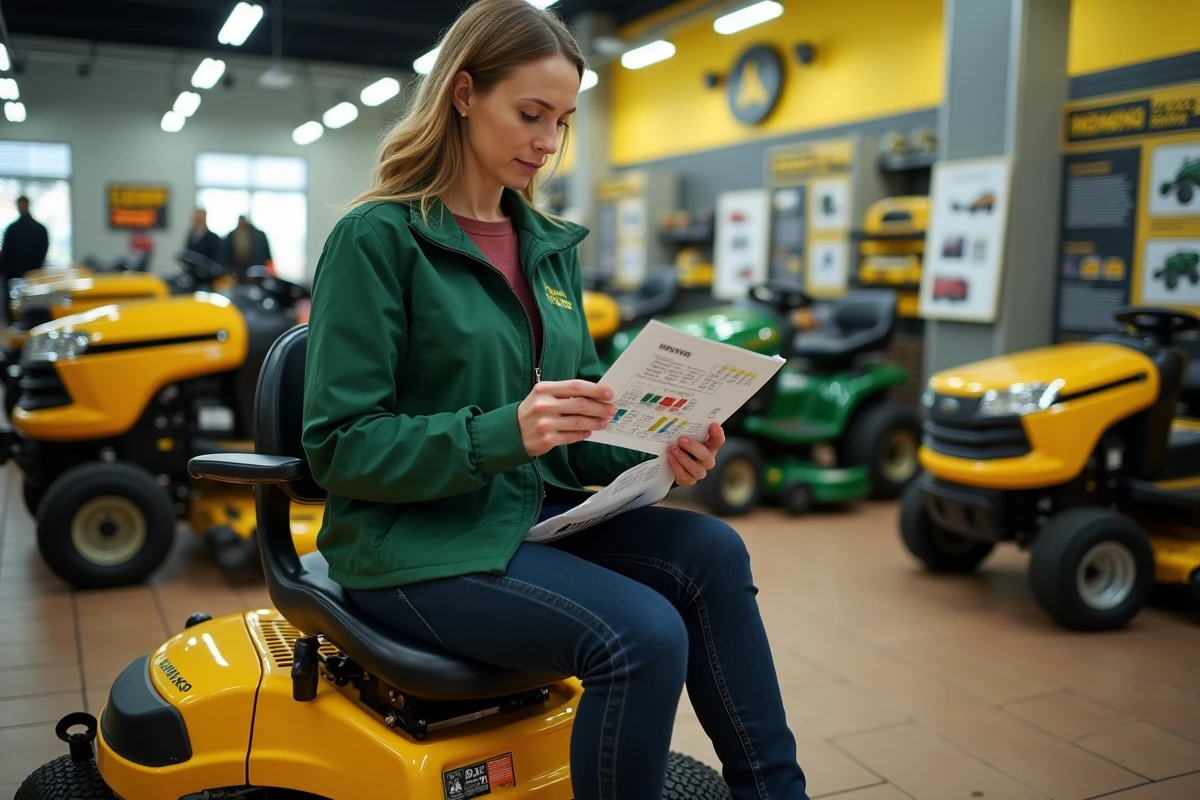
Cutting width and terrain area: the criterion that eliminates half the models
Have you noticed that cutting widths vary greatly from one tractor to another? It’s not a cosmetic detail. It’s the parameter that determines your mowing time and, by extension, your comfort of use.
The principle is simple: the wider the cutting deck, the fewer passes you need to make. On a small area (around the threshold where a tractor starts to make sense), a modest width is sufficient. On a significantly larger terrain, a narrow cut turns every mowing session into a chore lasting several hours.
How to reason in practice
- Terrain up to about 2,000 m²: a standard entry-level cutting deck is suitable. The time savings compared to a push mower are already considerable, so there’s no need to oversize.
- Terrain between 2,000 and 4,000 m²: aim for an intermediate cutting width and an engine with enough torque to handle tall or wet grass without straining.
- Beyond 4,000 m²: prioritize the widest deck available within your budget. Every additional centimeter saves you time with each pass.
At Brico Dépôt, compare the technical sheets on this specific point. The cutting width is a better indicator of comfort than the raw power of the engine.
Discharge, bag, or mulching: adapting the grass collection system to your lawn
The grass management system directly influences the visual result of your lawn and the time you spend after mowing.
Side discharge throws the grass to the side. It’s the simplest and quickest system, but it leaves clumps of grass on the lawn. Acceptable on a rustic terrain, less so on a well-kept lawn.
The collection bag gathers the clippings. The result is clean, but you have to empty the bag regularly. On a large area, the trips to the composter can become burdensome.
Mulching finely chops the grass and redistributes it on the ground. It decomposes and nourishes the lawn. It’s the most eco-friendly and least demanding solution, provided you mow regularly (the grass shouldn’t be too tall for effective mulching).
Some ride-on mowers offer all three options via an adaptable kit. Check if the model you’re interested in at Brico Dépôt includes the original mulching kit or if it needs to be purchased separately.
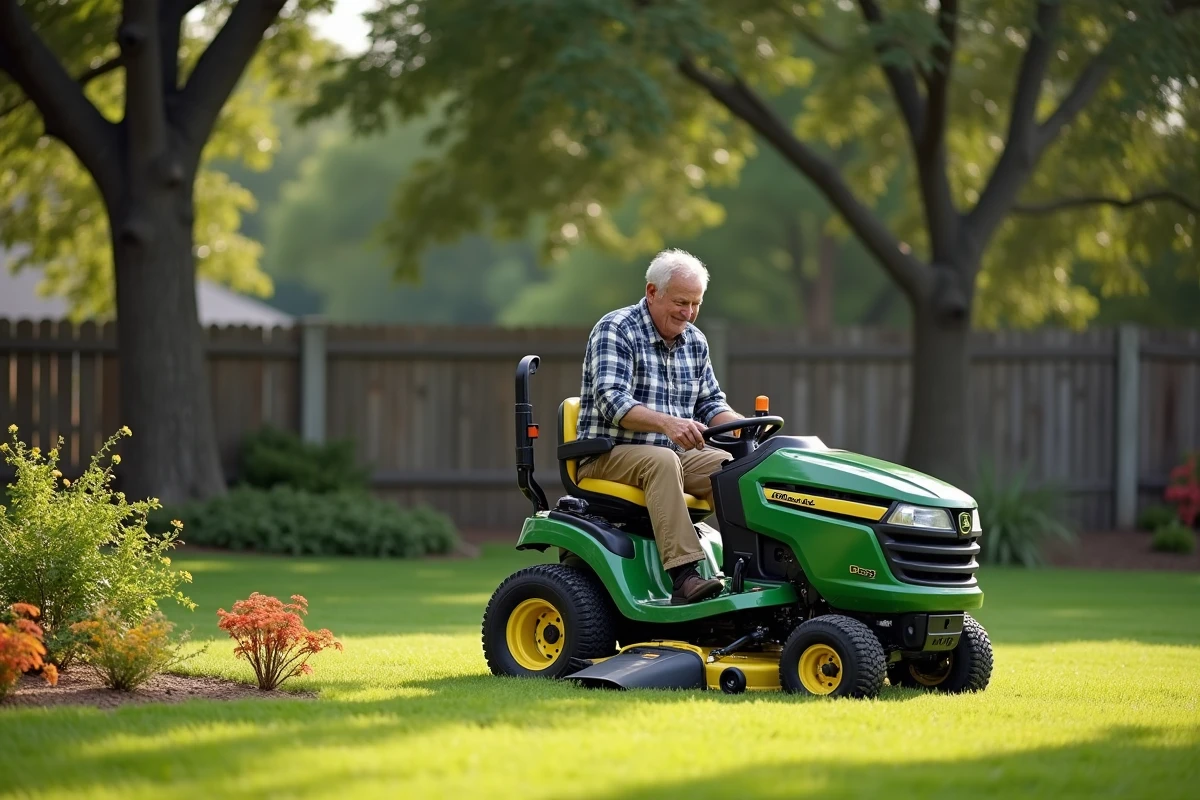
Driving comfort and transmission: details that matter over time
You will spend time on a ride-on mower. Driving comfort is not a luxury; it’s a functional criterion.
Mechanical or hydrostatic transmission
Mechanical transmission (with gears) is more affordable. You change gears manually, like in a manual car. It’s sufficient on flat, open terrain.
Hydrostatic transmission allows you to vary speed without disengaging, with a simple pedal. On terrain with obstacles (trees, flower beds, slopes), the difference in maneuverability is clear. It’s an additional expense, but it also makes mowing enjoyable rather than tiring.
Turning radius and seating
A tight turning radius saves you unnecessary maneuvers around trees and at the end of the plot. Test it if the store displays the machine. The seat should be firm enough not to strain your back after an hour of mowing.
- Check that the seat is adjustable in height and tilt.
- Test access to controls (cutting lever, parking brake) from a seated position.
- See if the engine cover opens easily for routine maintenance.
These points are not always listed on online product sheets. A trial in-store remains the best selection filter before finalizing your ride-on mower purchase at Brico Dépôt.
The right reflex is to cross-reference the cutting width suitable for your area, the type of collection that matches your usage, and a transmission level consistent with the topography of your terrain. A well-chosen ride-on mower on these three axes will serve you for years without regret.